




Divergence
Understand what divergence is. Divergence is a measure of source or sink at a particular point. – In other words, how much is flowing into or out of a point. Hence, it is only defined for vector fields and outputs a scalar. Below is an example of a field with a positive divergence. The divergence is recognized by div {\displaystyle \operatorname {div} } \operatorname {div} or ∇ ⋅ {\displaystyle \nabla \cdot } \nabla \cdot , where the dot signifies the similarity to taking a dot product.Vector_field_explosion.png
Take the dot product of the partial derivatives with the components of F {\displaystyle \mathbf {F} } {\mathbf {F}}, then sum the results. This applies for vector fields F = F x x ^ + F y y ^ + F z z ^ {\displaystyle \mathbf {F} =F_{x}\mathbf {\hat {x}} +F_{y}\mathbf {\hat {y}} +F_{z}\mathbf {\hat {z}} } {\mathbf {F}}=F_{{x}}{\mathbf {{\hat {x}}}}+F_{{y}}{\mathbf {{\hat {y}}}}+F_{{z}}{\mathbf {{\hat {z}}}} defined in Cartesian coordinates only. ∇ ⋅ F = ( ∂ ∂ x , ∂ ∂ y , ∂ ∂ z ) ⋅ ( F x , F y , F z ) = ∂ F x ∂ x + ∂ F y ∂ y + ∂ F z ∂ z {\displaystyle \nabla \cdot \mathbf {F} =\left({\frac {\partial }{\partial x}},{\frac {\partial }{\partial y}},{\frac {\partial }{\partial z}}\right)\cdot (F_{x},F_{y},F_{z})={\frac {\partial F_{x}}{\partial x}}+{\frac {\partial F_{y}}{\partial y}}+{\frac {\partial F_{z}}{\partial z}}} \nabla \cdot {\mathbf {F}}=\left({\frac {\partial }{\partial x}},{\frac {\partial }{\partial y}},{\frac {\partial }{\partial z}}\right)\cdot (F_{{x}},F_{{y}},F_{{z}})={\frac {\partial F_{{x}}}{\partial x}}+{\frac {\partial F_{{y}}}{\partial y}}+{\frac {\partial F_{{z}}}{\partial z}}
Use the formulas below as a reference. If the vector field F {\displaystyle \mathbf {F} } {\mathbf {F}} is given in cylindrical ( ρ , ϕ , z ) {\displaystyle (\rho ,\phi ,z)} (\rho ,\phi ,z) or spherical coordinates ( r , θ , ϕ ) {\displaystyle (r,\theta ,\phi )} (r,\theta ,\phi ) (where θ {\displaystyle \theta } \theta is the polar angle), then the divergence does not have a simple form. ∂ F x ∂ x + ∂ F y ∂ y + ∂ F z ∂ z {\displaystyle {\frac {\partial F_{x}}{\partial x}}+{\frac {\partial F_{y}}{\partial y}}+{\frac {\partial F_{z}}{\partial z}}} {\frac {\partial F_{{x}}}{\partial x}}+{\frac {\partial F_{{y}}}{\partial y}}+{\frac {\partial F_{{z}}}{\partial z}} 1 ρ ∂ ( ρ F ρ ) ∂ ρ + 1 ρ ∂ F ϕ ∂ ϕ + ∂ F z ∂ z {\displaystyle {\frac {1}{\rho }}{\frac {\partial (\rho F_{\rho })}{\partial \rho }}+{\frac {1}{\rho }}{\frac {\partial F_{\phi }}{\partial \phi }}+{\frac {\partial F_{z}}{\partial z}}} {\frac {1}{\rho }}{\frac {\partial (\rho F_{{\rho }})}{\partial \rho }}+{\frac {1}{\rho }}{\frac {\partial F_{{\phi }}}{\partial \phi }}+{\frac {\partial F_{{z}}}{\partial z}} 1 r 2 ∂ ( r 2 F r ) ∂ r + 1 r sin θ ∂ ∂ θ ( F θ sin θ ) + 1 r sin θ ∂ F ϕ ∂ ϕ {\displaystyle {\frac {1}{r^{2}}}{\frac {\partial (r^{2}F_{r})}{\partial r}}+{\frac {1}{r\sin \theta }}{\frac {\partial }{\partial \theta }}(F_{\theta }\sin \theta )+{\frac {1}{r\sin \theta }}{\frac {\partial F_{\phi }}{\partial \phi }}} {\frac {1}{r^{{2}}}}{\frac {\partial (r^{{2}}F_{{r}})}{\partial r}}+{\frac {1}{r\sin \theta }}{\frac {\partial }{\partial \theta }}(F_{{\theta }}\sin \theta )+{\frac {1}{r\sin \theta }}{\frac {\partial F_{{\phi }}}{\partial \phi }}
Calculate the divergence of the following function. F = ( 3 x 2 − 5 x 2 y 4 ) x ^ + ( x y 4 z 2 − sin ( 2 x 2 z 3 ) ) y ^ + ( 5 z 2 + y z ) z ^ {\displaystyle \mathbf {F} =(3x^{2}-5x^{2}y^{4})\mathbf {\hat {x}} +(xy^{4}z^{2}-\sin(2x^{2}z^{3}))\mathbf {\hat {y}} +(5z^{2}+yz)\mathbf {\hat {z}} } {\mathbf {F}}=(3x^{{2}}-5x^{{2}}y^{{4}}){\mathbf {{\hat {x}}}}+(xy^{{4}}z^{{2}}-\sin(2x^{{2}}z^{{3}})){\mathbf {{\hat {y}}}}+(5z^{{2}}+yz){\mathbf {{\hat {z}}}} ∇ ⋅ F = 6 x − 10 x y 4 + 4 x y 3 z 2 + y + 10 z {\displaystyle \nabla \cdot \mathbf {F} =6x-10xy^{4}+4xy^{3}z^{2}+y+10z} \nabla \cdot {\mathbf {F}}=6x-10xy^{{4}}+4xy^{{3}}z^{{2}}+y+10z As you can see, we have mapped from a vector field to a scalar field.
Curl

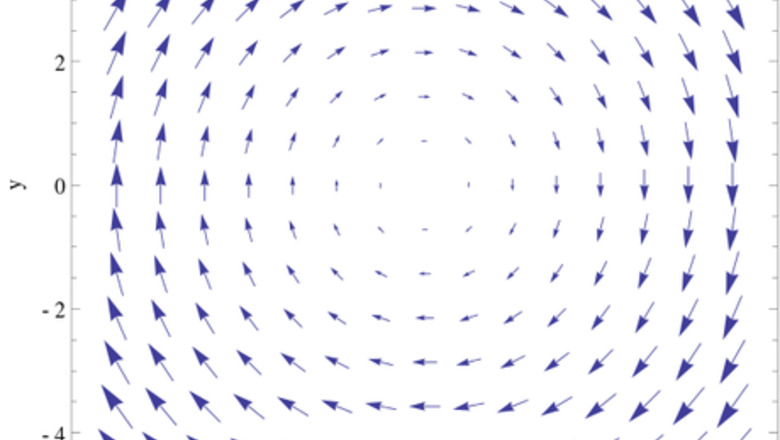
Understand what curl is. The curl, defined for vector fields, is, intuitively, the amount of circulation at any point. The operator outputs another vector field. A whirlpool in real life consists of water acting like a vector field with a nonzero curl. Above is an example of a field with negative curl (because it's rotating clockwise). The curl is recognized by curl {\displaystyle \operatorname {curl} } \operatorname {curl} or ∇ × {\displaystyle \nabla \times } \nabla \times , where the times symbol signifies the similarity of taking a cross product.
Set up the determinant. The curl of a function is similar to the cross product of two vectors, hence why the curl operator is denoted with a ∇ × . {\displaystyle \nabla \times .} \nabla \times . As before, this mnemonic only works if F {\displaystyle \mathbf {F} } {\mathbf {F}} is defined in Cartesian coordinates. ∇ × F = | x ^ y ^ z ^ ∂ / ∂ x ∂ / ∂ y ∂ / ∂ z F x F y F z | {\displaystyle \nabla \times \mathbf {F} ={\begin{vmatrix}\mathbf {\hat {x}} &\mathbf {\hat {y}} &\mathbf {\hat {z}} \\\partial /\partial x&\partial /\partial y&\partial /\partial z\\F_{x}&F_{y}&F_{z}\end{vmatrix}}} \nabla \times {\mathbf {F}}={\begin{vmatrix}{\mathbf {{\hat {x}}}}&{\mathbf {{\hat {y}}}}&{\mathbf {{\hat {z}}}}\\\partial /\partial x&\partial /\partial y&\partial /\partial z\\F_{{x}}&F_{{y}}&F_{{z}}\end{vmatrix}}
Find the determinant of the matrix. Below, we do it by cofactor expansion (expansion by minors). ∇ × F = ( ∂ F z ∂ y − ∂ F y ∂ z ) x ^ − ( ∂ F z ∂ x − ∂ F x ∂ z ) y ^ + ( ∂ F y ∂ x − ∂ F x ∂ y ) z ^ {\displaystyle \nabla \times \mathbf {F} =\left({\frac {\partial F_{z}}{\partial y}}-{\frac {\partial F_{y}}{\partial z}}\right)\mathbf {\hat {x}} -\left({\frac {\partial F_{z}}{\partial x}}-{\frac {\partial F_{x}}{\partial z}}\right)\mathbf {\hat {y}} +\left({\frac {\partial F_{y}}{\partial x}}-{\frac {\partial F_{x}}{\partial y}}\right)\mathbf {\hat {z}} } \nabla \times {\mathbf {F}}=\left({\frac {\partial F_{{z}}}{\partial y}}-{\frac {\partial F_{{y}}}{\partial z}}\right){\mathbf {{\hat {x}}}}-\left({\frac {\partial F_{{z}}}{\partial x}}-{\frac {\partial F_{{x}}}{\partial z}}\right){\mathbf {{\hat {y}}}}+\left({\frac {\partial F_{{y}}}{\partial x}}-{\frac {\partial F_{{x}}}{\partial y}}\right){\mathbf {{\hat {z}}}}
Use the formulas below as a reference. The curl does not have a simple form if F {\displaystyle \mathbf {F} } {\mathbf {F}} is in cylindrical or spherical coordinates. ( ∂ F z ∂ y − ∂ F y ∂ z ) x ^ − ( ∂ F z ∂ x − ∂ F x ∂ z ) y ^ + ( ∂ F y ∂ x − ∂ F x ∂ y ) z ^ {\displaystyle \left({\frac {\partial F_{z}}{\partial y}}-{\frac {\partial F_{y}}{\partial z}}\right)\mathbf {\hat {x}} -\left({\frac {\partial F_{z}}{\partial x}}-{\frac {\partial F_{x}}{\partial z}}\right)\mathbf {\hat {y}} +\left({\frac {\partial F_{y}}{\partial x}}-{\frac {\partial F_{x}}{\partial y}}\right)\mathbf {\hat {z}} } \left({\frac {\partial F_{{z}}}{\partial y}}-{\frac {\partial F_{{y}}}{\partial z}}\right){\mathbf {{\hat {x}}}}-\left({\frac {\partial F_{{z}}}{\partial x}}-{\frac {\partial F_{{x}}}{\partial z}}\right){\mathbf {{\hat {y}}}}+\left({\frac {\partial F_{{y}}}{\partial x}}-{\frac {\partial F_{{x}}}{\partial y}}\right){\mathbf {{\hat {z}}}} ( 1 ρ ∂ F z ∂ ϕ − ∂ F ϕ ∂ z ) ρ ^ − ( ∂ F z ∂ ρ − ∂ F ρ ∂ z ) ϕ ^ + 1 ρ ( ∂ ( ρ F ϕ ) ∂ ρ − ∂ F ρ ∂ ϕ ) z ^ {\displaystyle \left({\frac {1}{\rho }}{\frac {\partial F_{z}}{\partial \phi }}-{\frac {\partial F_{\phi }}{\partial z}}\right){\boldsymbol {\hat {\rho }}}-\left({\frac {\partial F_{z}}{\partial \rho }}-{\frac {\partial F_{\rho }}{\partial z}}\right){\boldsymbol {\hat {\phi }}}+{\frac {1}{\rho }}\left({\frac {\partial (\rho F_{\phi })}{\partial \rho }}-{\frac {\partial F_{\rho }}{\partial \phi }}\right)\mathbf {\hat {z}} } \left({\frac {1}{\rho }}{\frac {\partial F_{{z}}}{\partial \phi }}-{\frac {\partial F_{{\phi }}}{\partial z}}\right){\boldsymbol {{\hat {\rho }}}}-\left({\frac {\partial F_{{z}}}{\partial \rho }}-{\frac {\partial F_{{\rho }}}{\partial z}}\right){\boldsymbol {{\hat {\phi }}}}+{\frac {1}{\rho }}\left({\frac {\partial (\rho F_{{\phi }})}{\partial \rho }}-{\frac {\partial F_{{\rho }}}{\partial \phi }}\right){\mathbf {{\hat {z}}}} 1 r sin θ ( ∂ ∂ θ ( F ϕ sin θ ) − ∂ F θ ∂ ϕ ) r ^ − 1 r ( ∂ ∂ r ( r F ϕ ) − 1 sin θ ∂ F r ∂ ϕ ) θ ^ + 1 r ( ∂ ∂ r ( r F θ ) − ∂ F r ∂ θ ) ϕ ^ {\displaystyle {\begin{aligned}{\frac {1}{r\sin \theta }}\left({\frac {\partial }{\partial \theta }}(F_{\phi }\sin \theta )-{\frac {\partial F_{\theta }}{\partial \phi }}\right)\mathbf {\hat {r}} &-{\frac {1}{r}}\left({\frac {\partial }{\partial r}}(rF_{\phi })-{\frac {1}{\sin \theta }}{\frac {\partial F_{r}}{\partial \phi }}\right){\boldsymbol {\hat {\theta }}}\\&+{\frac {1}{r}}\left({\frac {\partial }{\partial r}}(rF_{\theta })-{\frac {\partial F_{r}}{\partial \theta }}\right){\boldsymbol {\hat {\phi }}}\end{aligned}}} {\begin{aligned}{\frac {1}{r\sin \theta }}\left({\frac {\partial }{\partial \theta }}(F_{{\phi }}\sin \theta )-{\frac {\partial F_{{\theta }}}{\partial \phi }}\right){\mathbf {{\hat {r}}}}&-{\frac {1}{r}}\left({\frac {\partial }{\partial r}}(rF_{{\phi }})-{\frac {1}{\sin \theta }}{\frac {\partial F_{{r}}}{\partial \phi }}\right){\boldsymbol {{\hat {\theta }}}}\\&+{\frac {1}{r}}\left({\frac {\partial }{\partial r}}(rF_{{\theta }})-{\frac {\partial F_{{r}}}{\partial \theta }}\right){\boldsymbol {{\hat {\phi }}}}\end{aligned}}
Calculate the curl of the following function. F = ( 5 x 2 y 2 − 7 x z 3 ) x ^ + ( 4 x − 5 x y − y 4 ) y ^ + ( x z + z 2 ) z ^ {\displaystyle \mathbf {F} =(5x^{2}y^{2}-7xz^{3})\mathbf {\hat {x}} +(4x-5xy-y^{4})\mathbf {\hat {y}} +(xz+z^{2})\mathbf {\hat {z}} } {\mathbf {F}}=(5x^{{2}}y^{{2}}-7xz^{{3}}){\mathbf {{\hat {x}}}}+(4x-5xy-y^{{4}}){\mathbf {{\hat {y}}}}+(xz+z^{{2}}){\mathbf {{\hat {z}}}}
Set up the determinant. ∇ × F = | x ^ y ^ z ^ ∂ / ∂ x ∂ / ∂ y ∂ / ∂ z F x F y F z | {\displaystyle \nabla \times \mathbf {F} ={\begin{vmatrix}\mathbf {\hat {x}} &\mathbf {\hat {y}} &\mathbf {\hat {z}} \\\partial /\partial x&\partial /\partial y&\partial /\partial z\\F_{x}&F_{y}&F_{z}\end{vmatrix}}} \nabla \times {\mathbf {F}}={\begin{vmatrix}{\mathbf {{\hat {x}}}}&{\mathbf {{\hat {y}}}}&{\mathbf {{\hat {z}}}}\\\partial /\partial x&\partial /\partial y&\partial /\partial z\\F_{{x}}&F_{{y}}&F_{{z}}\end{vmatrix}} F x = 5 x 2 y 2 − 7 x z 3 {\displaystyle F_{x}=5x^{2}y^{2}-7xz^{3}} F_{{x}}=5x^{{2}}y^{{2}}-7xz^{{3}} F y = 4 x − 5 x y − y 4 {\displaystyle F_{y}=4x-5xy-y^{4}} F_{{y}}=4x-5xy-y^{{4}} F z = x z + z 2 {\displaystyle F_{z}=xz+z^{2}} F_{{z}}=xz+z^{{2}}
Calculate the determinant. ( ∂ F z ∂ y − ∂ F y ∂ z ) x ^ = 0 − 0 {\displaystyle \left({\frac {\partial F_{z}}{\partial y}}-{\frac {\partial F_{y}}{\partial z}}\right)\mathbf {\hat {x}} =0-0} \left({\frac {\partial F_{{z}}}{\partial y}}-{\frac {\partial F_{{y}}}{\partial z}}\right){\mathbf {{\hat {x}}}}=0-0 ( ∂ F z ∂ x − ∂ F x ∂ z ) y ^ = z − ( − 21 x z 2 ) {\displaystyle \left({\frac {\partial F_{z}}{\partial x}}-{\frac {\partial F_{x}}{\partial z}}\right)\mathbf {\hat {y}} =z-(-21xz^{2})} \left({\frac {\partial F_{{z}}}{\partial x}}-{\frac {\partial F_{{x}}}{\partial z}}\right){\mathbf {{\hat {y}}}}=z-(-21xz^{{2}}) ( ∂ F y ∂ x − ∂ F x ∂ y ) z ^ = ( 4 − 5 y ) − 10 x 2 y {\displaystyle \left({\frac {\partial F_{y}}{\partial x}}-{\frac {\partial F_{x}}{\partial y}}\right)\mathbf {\hat {z}} =(4-5y)-10x^{2}{y}} \left({\frac {\partial F_{{y}}}{\partial x}}-{\frac {\partial F_{{x}}}{\partial y}}\right){\mathbf {{\hat {z}}}}=(4-5y)-10x^{2}{y}
Arrive at the answer. ∇ × F = − ( z + 21 x z 2 ) y ^ + ( 4 − 5 y − 10 x 2 y ) z ^ {\displaystyle \nabla \times \mathbf {F} =-(z+21xz^{2})\mathbf {\hat {y}} +(4-5y-10x^{2}y)\mathbf {\hat {z}} } \nabla \times {\mathbf {F}}=-(z+21xz^{{2}}){\mathbf {{\hat {y}}}}+(4-5y-10x^{{2}}y){\mathbf {{\hat {z}}}} Note that we have mapped to another vector field.






Comments
0 comment